

Therapy for Men in San Francisco
“I can figure it out.”
“It’s not that bad.”
“Other people have bigger problems.”
“I just need to get through this week.”
“I don’t need help. I need to get my shit together.”
And perhaps the most important one:
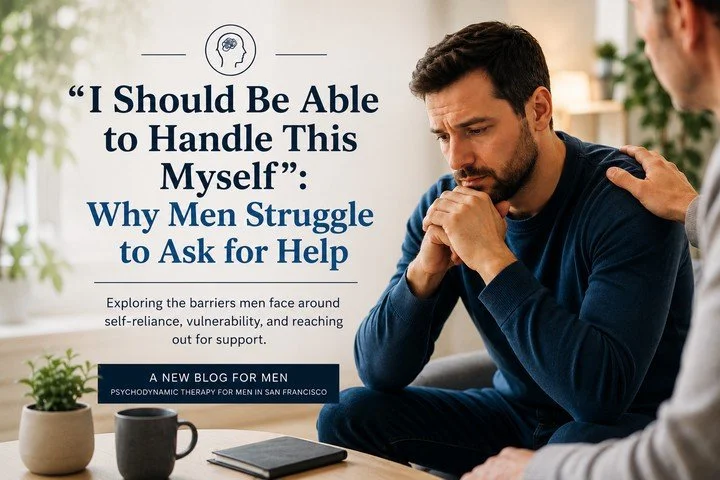
“I should be able to handle this myself.”
For many men, asking for help is not difficult because they do not want things to get better. The difficult part is what needing help seems to mean about them.
If you are used to being independent, capable, and self-reliant, asking someone for support can feel strangely uncomfortable. You may have no problem helping other people. You might be the person friends call when something goes wrong. But when you are the one struggling, something changes.
You minimize it. You wait. You work harder. You distract yourself. You tell yourself you'll deal with it later.
Sometimes later becomes months or years.
So, why do men struggle to ask for help—even when they know they need it?
The answer is more complicated than the stereotype that “men don't talk about their feelings.” From a psychodynamic perspective, the more interesting question is what asking for help represents psychologically for a particular man.
For some, it means weakness. For others, dependency. Failure. Exposure. Loss of control. Burdening someone else. Admitting that the problem is real.
And sometimes the hardest part is simply allowing another person to see that you cannot manage everything alone.
Why Is Asking for Help So Difficult for Some Men?
There are cultural reasons.
Many boys receive messages about independence and emotional control from an early age. Some are explicit: be tough, don't cry, handle your problems, don't let people see that something got to you.
Others are much subtler.
A boy may notice that adults respond differently when he is angry than when he is frightened. He may be praised for being independent. Perhaps vulnerability makes his father uncomfortable. Maybe sadness is quickly redirected toward problem-solving.
Nobody necessarily tells him, “You aren't allowed to need people.”
He simply begins to understand which parts of himself seem welcome and which are better handled privately.
Research on men's help-seeking has repeatedly found that masculine norms involving self-reliance and emotional control can become barriers to seeking psychological support (Addis & Mahalik, 2003; Seidler et al., 2016).
But cultural expectations alone do not explain why asking for help feels relatively easy for some men and almost intolerable for others.
For that, we have to look at the individual.
“I Should Be Able to Figure This Out”
Imagine that you are struggling at work.
You have been sleeping poorly for months. You're constantly thinking about work after you leave the office. You're irritable with your partner. Sundays have started to feel terrible because Monday is coming.
Your partner notices.
“You haven't seemed like yourself lately.”
You shrug.
“Work is just crazy.”
A few weeks later, they suggest talking to someone.
You immediately think:
Why? What is a therapist going to tell me that I don't already know?
You understand the problem.
Your job is stressful.
Your boss is difficult.
You need better boundaries.
You should exercise more.
You should stop checking email at night.
You already know all of this.
And that can become another reason not to seek help:
If I understand the problem intellectually, I should be able to fix it myself.
But understanding something and changing it are not the same psychological process.
You can understand perfectly well that your relationship pattern is unhealthy and still repeat it.
You can know that your standards for yourself are unrealistic and continue to feel like a failure when you don't meet them.
You can recognize that you are burned out and still be unable to slow down.
Sometimes the question isn't “What should I do?”
It's “Why is it so difficult for me to do what I already know?”
That is a very different question.
And it is one that psychodynamic therapy takes seriously.
Asking for Help Can Feel Like Admitting Failure
For some men, needing help conflicts with how they understand themselves.
Maybe you are the competent one.
The successful one.
The responsible one.
The person who solves problems.
Your ability to handle difficult situations may genuinely be one of your greatest strengths.
But strengths can become rigid.
If your identity is organized around being capable, needing someone can create an uncomfortable contradiction:
If I am the person who handles things, what does it mean that I can't handle this?
Suddenly, asking for help isn't merely practical.
It becomes a statement about who you are.
This is particularly important for men whose self-esteem is strongly connected to competence and achievement.
A problem at work isn't just a problem.
It becomes:
Maybe I'm not good enough.
Difficulty in a relationship isn't simply something two people need to address.
It becomes:
Maybe I'm failing at this.
Emotional distress isn't something you're experiencing.
It becomes:
Something is wrong with me.
Once the problem becomes connected to shame, hiding it can feel safer than addressing it.
Why Men Sometimes Wait Until Things Get Really Bad
There is a pattern many therapists recognize.
A man knows something isn't working.
He waits.
His partner has been asking him to go to therapy for a year.
He waits.
His anxiety gets worse.
He waits.
He starts sleeping badly.
He waits.
The relationship deteriorates.
He waits.
Then something happens.
His partner says they might leave.
He has a panic attack.
His work performance suffers.
He realizes he has become emotionally numb.
He can't stop drinking.
He loses someone important.
Suddenly, therapy becomes possible.
Why?
Because the crisis has finally made one thing undeniable:
The current way of coping is no longer working.
The tragedy is not that men are incapable of asking for help.
It is that some men have learned that asking for help is justified only after they have exhausted every other possibility.
“Other People Have It Worse”
This sentence sounds compassionate.
And sometimes it is.
Perspective can be useful.
But it can also become an elegant way of dismissing yourself.
Your relationship is falling apart, but someone else is getting divorced.
You're anxious, but you still go to work.
You're depressed, but you're functioning.
You're lonely, but you have friends.
You're unhappy, but your life looks good on paper.
So you conclude:
I shouldn't complain.
Notice the standard hidden inside that statement.
Your suffering apparently becomes legitimate only if nobody else is suffering more.
We rarely apply that logic to physical pain.
You wouldn't tell someone with a broken wrist that they shouldn't see a doctor because another person has cancer.
But emotional pain often gets treated differently.
Particularly when you are accustomed to minimizing your own needs.
“I Don’t Want to Burden Anyone”
This may be one of the most powerful barriers to asking for help.
You don't want your partner to worry.
Your parents already have enough going on.
Your friends are busy.
You don't want to be the guy who constantly talks about his problems.
So you keep things to yourself.
There is something generous in wanting to protect other people.
But there can also be an unconscious assumption underneath it:
My needs are too much.
Perhaps this assumption is familiar.
Maybe you grew up in a family where one parent's emotions took up most of the room.
Perhaps your parents were overwhelmed.
Maybe there was illness, financial stress, conflict, addiction, or instability.
You learned to be easy.
Independent.
Low maintenance.
You became the child who didn't cause problems.
Years later, you may still feel vaguely uncomfortable when attention turns toward your needs.
You don't think:
I wasn't allowed to need people growing up.
You simply say:
“I'm not really someone who asks for help.”
Psychodynamic therapy is interested in how one became the other.
When Independence Becomes Emotional Self-Sufficiency
Independence is usually considered a strength.
And it often is.
But there is an important difference between being capable of functioning independently and believing you should not need anyone emotionally.
Healthy adulthood does not mean eliminating dependency.
It means developing a more flexible relationship with it.
You can take care of yourself and allow someone to take care of you.
You can make your own decisions and ask for advice.
You can be emotionally resilient and tell someone you're struggling.
You can solve problems and admit that you don't know what to do.
This is better described as interdependence.
But for some men, dependency carries uncomfortable meanings.
Dependency may feel childish.
Weak.
Dangerous.
Embarrassing.
Or simply unfamiliar.
If you learned early that relying on other people often led to disappointment, extreme self-reliance may have developed for a very good reason.
If I don't need anyone, nobody can let me down.
That strategy protects you.
It can also make intimacy very difficult.
Why Asking for Help Requires Trust
When you ask someone for help, you surrender a small amount of control.
You reveal something.
You acknowledge that another person has something you need.
Then you wait to see what they do with that information.
Will they understand?
Judge you?
Dismiss you?
Try to fix you?
Use it against you later?
Feel overwhelmed?
Tell someone else?
For a person with a history of unreliable or intrusive relationships, these questions may carry enormous emotional weight.
This is why telling someone to “just open up” can miss the point.
People usually have reasons for protecting themselves.
The question is whether the protection that once made sense is still necessary in every relationship today.
The Man Everyone Depends On
Consider Michael, a fictional example based on a common clinical pattern.
Michael is 38 and works in technology in San Francisco. He is successful, financially secure, and highly competent.
People describe him as calm.
His younger sister calls him when she has problems.
His parents ask him for advice.
At work, he is the person colleagues trust during difficult projects.
His partner describes him as dependable but emotionally difficult to reach.
Michael doesn't understand the complaint.
He is always there.
He pays attention.
He solves problems.
If his partner's car breaks down, Michael handles it.
If they are stressed about work, he gives advice.
If something needs to be organized, he organizes it.
Then Michael's company restructures.
His position becomes uncertain.
For the first time in years, he feels genuinely frightened.
But he tells nobody.
His partner notices he is distant and asks what is wrong.
“Nothing.”
“Are you worried about work?”
“I'll figure it out.”
Weeks pass.
Michael becomes increasingly irritable.
His partner feels pushed away.
One night they argue.
His partner says:
“You help everybody. Why won't you let anybody help you?”
Michael doesn't know how to answer.
The problem isn't that he doesn't trust his partner.
At least not consciously.
The problem is that Michael has built much of his identity around being the person who doesn't need help.
Letting someone support him feels almost like becoming a different person.
Why Some Men Shut Down Instead of Asking for Support
This connects directly to another pattern I have written about: men shutting down during arguments.
Imagine an argument with your partner.
You already feel criticized.
Your partner asks:
“What are you feeling right now?”
You don't know what to say.
They ask again.
You feel pressure building.
Perhaps what you actually feel is:
I'm scared you're disappointed in me.
Or:
I don't know how to make you happy anymore.
Or:
I'm afraid you're going to leave.
Those are vulnerable statements.
Instead, you say:
“I don't want to talk about this.”
You walk away.
Your partner experiences withdrawal.
You experience self-protection.
This is one reason difficulty asking for help is not simply about therapy or mental health treatment.
It can shape romantic relationships, friendships, family relationships, and even the way men handle conflict.
“I Don’t Even Know What I Need”
Sometimes asking for help is difficult for a simpler reason:
You don't know what to ask for.
Your partner says:
“What do you need from me?”
And your mind goes blank.
This can be confusing.
But if you have spent years focusing on what needs to be done rather than what you need emotionally, the answer may genuinely be unclear.
Do you want advice?
Reassurance?
Space?
Affection?
Someone to listen?
Someone to tell you that you aren't failing?
You may be much better at identifying problems than identifying needs.
That doesn't mean you don't have needs.
It may mean you have had less practice recognizing them.
The Connection Between Asking for Help and Always Having to Be Strong
This is where the current article connects closely with my previous piece, “Why Do I Feel Like I Always Have to Be Strong?”
If your internal rule is:
I have to be strong,
then asking for help creates a problem.
Because asking for help requires acknowledging:
Right now, I can't do everything alone.
For someone with a flexible sense of strength, those ideas can coexist.
For someone whose identity depends on self-sufficiency, they may feel incompatible.
That is why simply encouraging men to “be more vulnerable” often doesn't go far enough.
We need to understand what vulnerability threatens.
Why Men Avoid Therapy
There are practical reasons people don't begin therapy: cost, time, availability, previous bad experiences, uncertainty about what therapy involves, and difficulty finding the right therapist.
But there can also be psychological reasons.
Going to therapy means acknowledging that something deserves attention.
For some men, even scheduling the first appointment makes the problem feel more real.
There may also be assumptions about what therapy will require.
Am I going to have to talk about my childhood?
What if I don't know what to say?
What if the therapist thinks my problems aren't serious?
What if I start talking and can't stop?
What if nothing changes?
And sometimes:
What if I discover something about myself that I don't want to know?
These are understandable concerns.
Therapy involves allowing another person to become curious about parts of your life you may have spent years managing privately.
That can feel exposing.
You Don't Have to Know What to Say in Therapy
Some men arrive at therapy believing they need to present their problem clearly.
They want to explain what is wrong.
Provide the relevant history.
Identify goals.
Develop a plan.
Essentially, they want to be a good therapy patient.
But therapy does not require you to arrive with a polished explanation of yourself.
You can begin with:
“I don't really know why I'm here.”
Or:
“My partner thinks I need therapy.”
Or:
“Nothing is terribly wrong, but I haven't felt like myself.”
Or:
“I have a good life. I don't understand why I'm unhappy.”
Or even:
“I don't know what I'm supposed to talk about.”
All of those are places to begin.
Psychodynamic Therapy Asks a Different Question
A symptom-focused approach might ask:
How can we help you ask for help more often?
That can be useful.
A psychodynamic approach also asks:
Why is asking for help so emotionally difficult for you in the first place?
What do you imagine will happen?
What feelings emerge when someone sees you struggling?
What did dependence mean in your family?
Who was allowed to need things?
Who took care of whom?
What happened when you were frightened?
How was weakness treated?
What did you have to do to feel respected?
And perhaps most importantly:
What happens between you and the therapist when you begin to need something from them?
Because the pattern doesn't remain outside the therapy room.
Eventually, it appears there too.
You may minimize something painful.
Say you're fine.
Change the subject.
Worry about taking up too much time.
Feel embarrassed after sharing something personal.
Wonder whether the therapist thinks you're weak.
Want help while simultaneously resisting it.
Those moments are not failures of therapy.
They are therapy.
They allow the pattern to become visible in a relationship where it can be understood rather than simply repeated.
Asking for Help Is Not the Opposite of Independence
One of the most useful shifts is recognizing that independence and receiving support are not opposites.
You don't lose competence by asking someone for perspective.
You don't lose masculinity by acknowledging fear.
You don't become dependent because you need comfort.
And going to therapy does not mean handing responsibility for your life to someone else.
A therapist cannot live your life for you.
Cannot make your decisions.
Cannot remove uncertainty.
Cannot guarantee that relationships will work.
The work remains yours.
But it does not necessarily have to be done alone.
What If You Have Always Been the Strong One?
If you are the person everyone depends on, asking for help can feel particularly strange.
You may not even know where to begin.
Perhaps the first step is not suddenly becoming more vulnerable with everyone in your life.
Maybe it is simply becoming curious about the automatic thought:
I should be able to handle this myself.
Why should you?
Where did you learn that?
What would it mean if you couldn't?
Whose judgment are you anticipating?
And what might happen if someone saw that you were struggling and stayed?
Those questions can open something that advice alone cannot.
Therapy for Men in San Francisco
Many men do not begin therapy because they want to become “more emotional.”
They begin because something isn't working anymore.
A relationship keeps falling into the same conflict.
Work has become overwhelming.
Anxiety is increasing.
They feel disconnected.
They are successful but dissatisfied.
They keep choosing relationships that don't work.
They are angry more often.
They feel numb.
Or they have reached a point where saying “I'll figure it out” no longer feels convincing.
Psychodynamic therapy for men in San Francisco offers a space to understand not only what is happening, but why familiar patterns keep repeating even when you consciously want something different.
Asking for help does not require giving up independence.
Sometimes it begins with something much smaller:
allowing another person to know that you don't have everything figured out.
And seeing what happens next.
Start the Conversation
Frequently Asked Questions
Why do men struggle to ask for help?
There is no single reason. Cultural expectations around masculinity, self-reliance and emotional control can play a role, but individual experiences also matter. Some men associate needing help with weakness, failure, dependency, loss of control, or burdening others. Early family relationships can also influence whether relying on another person feels safe.
Why do men avoid therapy?
Men may avoid therapy for practical, cultural, or psychological reasons. Some are unsure what therapy involves, while others believe they should solve problems independently. Research has also found associations between certain traditional masculine norms, particularly self-reliance, and more negative attitudes toward psychological help-seeking.
Why do I feel weak when I ask for help?
If competence and independence are important parts of your identity, needing assistance can conflict with how you believe you are supposed to function. Asking for help may then trigger shame or inadequacy even when you would never judge another person for doing the same thing.
Why do I help everyone but never ask for help myself?
Being the helper can provide a sense of competence, control, usefulness, and connection while allowing you to avoid the vulnerability of receiving care. For some people, this pattern begins early when they become accustomed to being responsible or minimizing their own needs.
Why don't I know what I need when someone asks?
If you have spent years focusing on solving problems, meeting expectations, or caring for others, identifying emotional needs may be unfamiliar. Therapy can help develop greater awareness of feelings and needs without forcing emotional expression.
Is asking for help a sign of weakness?
No. Asking for appropriate support is compatible with independence and psychological resilience. Healthy adult functioning generally involves both the capacity to manage independently and the ability to rely on others when needed.
How can psychodynamic therapy help men who struggle to ask for help?
Psychodynamic therapy explores the meaning behind self-reliance rather than simply encouraging someone to behave differently. It can help identify how early relationships, self-esteem, defenses, expectations about masculinity, and fears about dependency influence present-day relationships and willingness to seek support.
Do I need to be in crisis before starting therapy?
No. Therapy does not require a crisis or psychiatric diagnosis. Some people begin because they recognize a recurring relationship or emotional pattern, feel dissatisfied despite functioning well, or simply want to understand themselves more deeply.
References
Addis, M. E., & Mahalik, J. R. (2003). Men, masculinity, and the contexts of help seeking. American Psychologist, 58(1), 5–14.
Berger, J. M., Levant, R., McMillan, K. K., Kelleher, W., & Sellers, A. (2005). Impact of gender role conflict, traditional masculinity ideology, alexithymia, and age on men's attitudes toward psychological help seeking. Psychology of Men & Masculinity, 6(1), 73–78.
Seidler, Z. E., Dawes, A. J., Rice, S. M., Oliffe, J. L., & Dhillon, H. M. (2016). The role of masculinity in men's help-seeking for depression: A systematic review. Clinical Psychology Review, 49, 106–118.
Wong, Y. J., Ho, M. H. R., Wang, S. Y., & Miller, I. S. K. (2017). Meta-analyses of the relationship between conformity to masculine norms and mental health-related outcomes. Journal of Counseling Psychology, 64(1), 80–93.
